
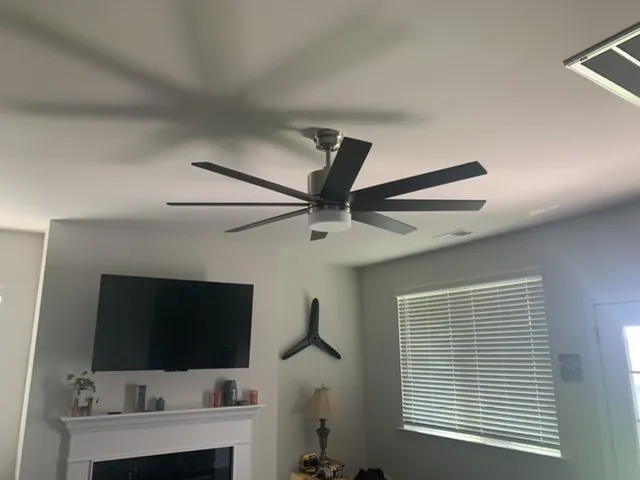
Ceiling fan installation cost is one of those questions that sounds like it should have one tidy answer. In practice, the fan itself is only part of the picture. The quickest jobs replace a working fixture in a location that already has the right support and wiring. The more the project moves away from that starting point, the more the estimate needs to account for access, materials and the electrical work behind the ceiling.
That is why two homeowners can buy similar fans and receive very different quotes. One may be swapping an old fan in a standard bedroom. The other may be adding a fan where there has never been a ceiling fixture, working below a vaulted ceiling or choosing a model for a covered porch. Looking at the conditions before scheduling helps you budget honestly and keeps a small comfort upgrade from turning into a surprise.
Start with the type of installation
The biggest pricing question is simple: is there already a suitable fixture location where the fan will go? Replacing an existing ceiling fan, or changing a light fixture at a properly prepared location, is usually the most predictable type of project. The installer can focus on removing the old fixture, mounting the new fan, making the right connections, balancing the blades and testing the controls.
A new location is different. It may need a safe support point, a switch plan and additional wiring. That is not something to guess at from a product photo. Electrical Safety Foundation International guidance is clear that permanent wiring is not something an extension cord should replace, and temporary adapters are not a substitute for the support a moving ceiling fan needs. See its advice on extension-cord safety and unsafe electrical adapters before trying to work around a missing ceiling location.

For a home-service quote, a few photos make this step much easier: one wide photo of the room, one of the ceiling location, one of the existing wall switch and one of the fan box or fixture if it is visible. If you already chose a fan, include the model link or the box label. Those details reveal whether the job is a straightforward replacement or needs a different trade involved.
What a realistic ceiling fan installation budget includes
National pricing guides are useful for understanding the range, but they are not a substitute for seeing the room. Angi currently places professional installation in a broad national range, and its cost guide specifically calls out fan type, ceiling height, wiring, permits and reinforcement as factors that can move the number. Its current installation cost guide is a helpful reference point. Thumbtack’s current estimate lands in a similar general range and is another reminder that a “fan install” can mean very different scopes of work.
For a local starting point, Got A List? Co. lists ceiling fan installation from $80 on its published pricing page. That is a useful baseline for a standard job, not a promise that every ceiling and every fan are identical. An accurate quote should reflect what is actually above the drywall and whether the requested work remains within the installer’s scope.
- The fan and its features: a basic pull-chain fan, a fan with a light kit and a smart fan with a remote do not all take the same setup and testing time.
- The existing box and support: a moving fan needs a secure, appropriate mounting point. If the existing location is not suitable, that should be identified before the fan is hung.
- The ceiling and access: standard-height rooms are simpler than tall foyers, stairwells and vaulted ceilings where access and mounting hardware matter more.
- The control plan: keeping the current switch is one thing; changing switches, adding a remote receiver or diagnosing a control issue is another.
- The location: indoor bedrooms, screened porches and exposed outdoor areas have different product and installation requirements.
Replacing a fan is different from adding one
Replacing an existing fan is often the easiest version of the project because the room already has a place designed for a ceiling fixture. It is still worth checking the details. An older fan may have been installed years ago, the switch may not behave the way you want, or the new fan may be heavier, wider or more feature-rich than the old one. A clear photo of the existing fan, ceiling canopy and wall control helps flag those questions early.
Replacing a light fixture with a fan can also be straightforward, but it should never be treated as automatic. The support behind a light fixture is not always the same as the support needed for a rotating fan. This is one of the reasons a quick site assessment is more valuable than a generic “per fan” price. It gives the person doing the work a chance to confirm the location is appropriate before the project starts.
Adding a fan where there is no existing ceiling fixture is the point where the project may cross into electrical work that needs a licensed electrician. The answer depends on the home, the location, the switch plan and local requirements. That is not bad news; it simply means the quote should separate the practical installation work from any electrical scope rather than blur them together. Homeowners get a better outcome when each part of the job is handled by the right professional.
Why ceiling height and room shape matter
High ceilings add more than ladder time. The right mounting style needs to keep the fan at a useful height, clear surrounding features and look intentional in the room. A vaulted ceiling can require a compatible mounting option and a longer downrod. A low ceiling may point toward a flush-mount model. Both choices affect the fan you buy and the work needed to install it cleanly.

Room size belongs in the decision too. A fan that looks good in a showroom can feel undersized in a large open living space or overpower a small bedroom. The U.S. Department of Energy measures ceiling-fan efficiency as airflow relative to power use, which is why published airflow and efficiency information is more useful than choosing based on blade count alone. Its ceiling fan guidance explains how these products are defined and regulated.
Before buying, measure the room, note the ceiling height and decide what the fan needs to do. Is it primarily for air movement? Do you also need a central light? Will a remote make everyday use easier? Is the fan meant for a bedroom, a wide living room or a covered porch? Those answers help avoid paying for a model that is wrong for the space.
Choose the fan before choosing the finish
Style matters, but it is not the first decision. Start with the room and how the fan will be used. A bedroom often benefits from quiet operation and simple controls. A family room may need stronger air movement and a light kit that works with the rest of the room. A tall great room may need a mounting style that brings the fan down to a useful height. A covered porch needs a model that belongs in that environment.
Then think through the everyday controls. A remote can be convenient, especially when the fan is mounted high or the room has several switches. Some homeowners prefer a wall control so guests can operate the fan without hunting for a remote. If the fan includes a light, check whether the lighting behavior fits the room: dimming, colour temperature, memory settings and separate fan/light control can all matter more than they seem in the aisle at the store.
There is also a practical buying rule: keep the packaging and instructions until the installation is complete. The mounting hardware, downrod options, receiver and remote are all part of the finished setup. If something appears missing or damaged, finding that out before the appointment is much easier than uncovering it with the old fan already down. For people comparing services, the service overview shows the other installations Got A List? Co. can handle while it is already helping with the list at home.
Indoor, covered porch and outdoor fans are not interchangeable
A covered porch can be one of the best places for a fan, especially through a Carolina summer. It also deserves a little more care in the buying stage. Moisture exposure, roof coverage and wind all affect the model that belongs there. The product rating matters, and the location may call for weather-conscious electrical work that should be assessed in person.

Do not assume that a fan that works in a dry bedroom belongs outdoors just because the porch has a roof. Bring the product specifications to the quote conversation. That lets the installer confirm the project is appropriate and identify early when a licensed electrician should handle the electrical portion.
How to get a useful quote before anyone arrives
The best quote request is short but specific. You do not need to know every electrical detail. You do need to describe the project honestly. A useful message includes the room, whether there is an existing fan or light, the ceiling height, the fan you picked and anything that feels unusual about the space.
It also helps to say what you want kept. Maybe you want the existing wall switch to remain simple, the remote to control both fan and light, or the blades to clear a nearby door. Those details are part of a successful installation, not finishing touches. The same goes for an older home where the fixture flickers, the switch is unreliable or the room has no ceiling outlet. Those are signals to pause and assess the electrical work rather than force a quick answer.
What a well-planned installation looks like
A good installation day should not feel chaotic. The homeowner and installer should agree on the fan location, confirm the model and controls, protect the immediate work area and review anything unusual before the old fixture comes down. For a standard replacement, the finish should include checking the fan’s movement, the light, the remote or wall control and the overall fit in the room.
It is also reasonable to ask what is included. Does the quoted work cover removing the old fan? Is the fan supplied by the homeowner? Does the price assume ordinary access? What happens if the existing support or wiring is not suitable? Clear answers prevent a quote from feeling vague. They also make it easier to decide whether to group several small projects into one visit, such as a fan, a new light fixture or a few items that need mounting.
Grouping practical jobs can be especially useful when you have a growing home list. The business already handles installation and repair projects like the ones shown in its gallery, so it is worth mentioning the other items you want addressed while you are sharing photos. The goal is not to turn one small fan project into a complicated renovation. It is to make one visit count when the jobs are clearly within scope.
When to choose professional help
A straightforward fan replacement can be a manageable home project for someone with the right experience and a suitable location. But it is not the right place to improvise around unclear wiring, a weak mounting point or a missing ceiling fixture. A fan moves every time it runs. Secure support, correct connections and proper testing matter.
Got A List? Co. handles practical home installations and repairs across the Carolinas, including standard ceiling fan work. When your project needs new circuits, panel work, major electrical troubleshooting or work that requires a licensed electrician, the honest answer is to bring in the right electrical professional. That keeps the job moving without pretending every problem belongs in the same bucket.
For a standard installation, the fastest route to a useful answer is to text the project details or request a free quote. Include those photos and the fan information, and you will have a much clearer path than trying to compare generic price ranges to a room no one has seen. Homeowners outside Charlotte can also check the current service areas before reaching out.
Frequently asked questions
A straightforward replacement with compatible wiring is usually the simplest case. The final price changes when the location needs a fan-rated box, a taller ladder setup, new wiring, a remote or switch change, or an outdoor-rated installation.
A qualified home-service professional can handle a straightforward installation within their scope. When the project needs new circuits, panel work, major troubleshooting or other electrical work that requires a licensed electrician, the right next step is an electrician.
No, but an existing fixture location can make planning simpler. A new location may require additional electrical work, which should be assessed before anyone promises a final price.
Buying the fan first is fine when you know the room, ceiling height and mounting style are a fit. A photo of the room, the existing fixture and the fan box gives an installer much better information to confirm the job.
Ready to get the fan checked off?
Send a photo of the room and the fan you have in mind. We’ll help you figure out the next practical step.
Request a Free Quote